Regular readers of
Murphblog know that I don't often review books. The pretend reasons for this are as follows:
1. I consider them beneath me. (Reviews, not books.)
2. I'm a writer,
Jim, not a reviewer!
3. I don't have the time.
4. Why should you care what I think about a book anyway?*
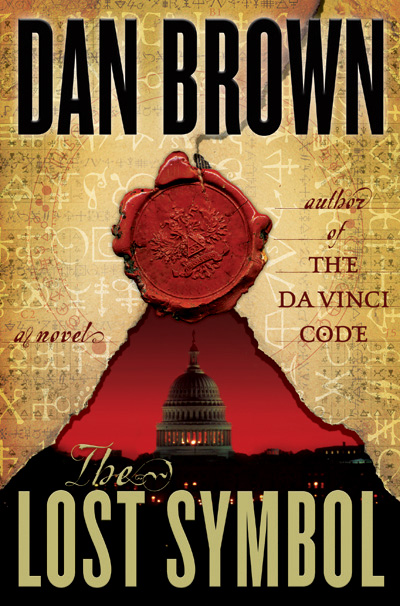
The real reason is I'm just not very good at writing them. And with that ringing self-endorsement, I present to you my review of Dan Brown's latest,
The Lost Symbol.
Summary:
Robert Langdon is back, although he mostly serves as a doubting Thomas who is constantly being told, "No, really, it's true. I'm telling you, it's totally true. Seriously, man, it is
so true. It's like, never been more truer than it is right now." This happens about thirty times.
Why's he back? Because this bad guy needs him to solve a bunch of pretty cool codes and stuff. See, the Freemasons, which is basically a fraternity of old white dudes with lots of secrets, have this thing called the Masonic Pyramid that is thought to hold the Ancient Mysteries, which is basically some secret wisdom from back when people where lots smarter than they are today. And the bad guy wants that wisdom because wisdom is powerful, yo.
Analysis:
If you liked
The Da Vinci Code, you'll probably like this. And the reason for that is simple: Brown basically Used the same structure and elements to tell a very similar story. I thought this was smart, since pre-
Da Vinci, Brown's sales weren't all that fantastic, and there would have been a whole lot of angry people if his new book was, say, a romantic comedy. Give the people what they want, or at least what think they want, that's what I say.** The Wife, who hasn't read the book yet, thought it was a stupid decision and believes Brown, having been granted the gift of clout, should have been a little more bold. As usual, I'm right, which makes her not.
Here's what I liked about the book:
1. Pacing--yeah, it's long. Yes, there are some unnecessary scenes and even chapters (but they're short), but the book moves pretty swiftly and you almost always have reason to turn the page (until the end, which drags a bit).
2. The codes are cool.
3. Like
Da Vinci, you learn a bunch of cool stuff. There's some history and some art and some tidbits about famous people and lots of stuff about Washington, D.C. Oh, and there's the Masons. Anyone with any curiosity can't help but google stuff from the book.
Here's what might drive you nuts:
The writing---Look, the writing isn't
bad in the way most people's writing is bad. It's not like Brown misuses words and drops run-on sentences all over the place. It's just not very
good. The most annoying thing is the confusing POV. It's in third person and each chapter is supposed to be told from the perspective of one of the characters. But Brown intrudes all over the place. If he needs to give you some background or explain the meaning of
apotheosis he just goes ahead and does it, even though the character would have no reason to think these things. And his use of italics is like Nails on a chalk board. Brown uses italics to tell what his characters are thinking and most of the time it's totally obnoxious. An example:
The "sactum sanctorum," as Mal'akh liked to call it, was a perfect twelve-foot square. Twelve are the signs of the zodiac. Twelve are the hours of the day. Twelve are the gates of heaven. In the center of the chamber was a stone table, a seven-by-seven square. Seven are the seals of Revelation. Seven are the steps of the Temple.
First, there's this weird back and forth between exposition and the character's thoughts, almost like Brown and his characters are taking turns. Second, Brown's characters are often thinking things they wouldn't be thinking. The "sactum sanctorum" referred to above was in the character's basement and he went there all the time. Are we really supposed to believe that every time he looked at the room and the table he thought of the symbolic significance of their sizes? It was grating.
2. Formulaic--A lot of the scenes follow the same pattern. Langdon is given information that he doesn't believe and somebody tries to convince him that he's wrong and eventually, he's forced to Admit that he was, in fact, wrong. After all he's seen, you'd expect him to be a little less skeptical.
Still, in spite of those and some other things (mostly to do with how the story was told, not the story itself), I enjoyed the book and I'll go back for more. It's been written that Brown has 12 more ideas for Robert Langdon books. Let's hope he loses the italics.
_______________________________
* You will note that this is a
pretend reason. You
should care. You should care passionately.
**I don't really say this, but I do think it. Sometimes.
_______________________________
If you're wondering about the capital letters--not a typo. You missed something. Check the old stuff.
 Boy howdy! The Literary Ramblin' Woman herself, Casey McCormick, just awarded me a rootin' tootin', hootin,' hollerin', positively boot scootin' award. Much obliged, cowgirl.
 Enough of that. I'm plum out of cowboy slang. The award is for projecting a positive outlook on my blog. You know, being my regular optimistic self. I'm now supposed to pass it on to five other uplifting bloggers. But first, I kind of feel like I need to prove I'm deserving.